Text
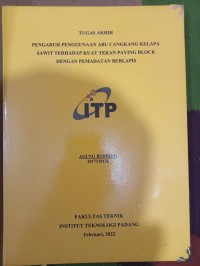
Pengaruh Penggunaan Abu Cangkang Kelapa Sawit Terhadap Kuat Tekan Paving Block dengan Pemadatan Berlapis
ABSTRACT
Paving block is a building material made from a mixture of cement, sand and water. Paving blocks are widely used in the construction sector, such as sidewalks, highways, parking lots, parks and so on. Ease of installation, cheap maintenance and fulfilling the aesthetic aspects make paving blocks more popular. Along with the many uses of paving blocks in the community, the quality of paving blocks must be improved. Making paving blocks using layer compaction and the use of oil palm shell ash. In general, oil palm shell ash contains SiO2 which is known as silica or silicic acid which is quite high without reducing the quality of the paving blocks. The research was carried out by compacting in three layers and using a mixture of palm shell ash with variations of 0%, 1%, 2%, 3% and 4% of the cement weight, using rectangular specimens with a size of 20 cm x 10 cm x 6 cm. 25 pieces with a compressive strength test age of 28 days. Based on the test results, the compressive strength value of paving blocks using 0% oil palm shell ash is 15.3 MPa, 1% palm shell ash is 17.64 MPa, 2% palm shell ash is 15.24 MPa, shell ash is 15.24 MPa. 3% palm oil obtained by 16.08 MPa. Oil palm shell ash 4% is 16.2 MPa. We can see that the manufacture of paving blocks by layer compaction and the use of oil palm shell ash on the compressive strength of paving blocks with variations of 0%, 1%, 2%, 3% and 4%, shows an increase in the compressive strength of the planned paving block. The highest compressive strength test was obtained at a mixture composition of 1% oil palm shell ash.
Keywords: Paving Block, Palm Oil Shell Ash, Compressive Strength
Ketersediaan
Informasi Detail
- Judul Seri
-
Tugas Akhr Teknik Sipil Sarjana
- No. Panggil
-
2221-001
- Penerbit
- Padang : Fakultas Teknik ITP., 2022
- Deskripsi Fisik
-
-
- Bahasa
-
Indonesia
- ISBN/ISSN
-
2017210126
- Klasifikasi
-
NONE
- Tipe Isi
-
text
- Tipe Media
-
computer
- Tipe Pembawa
-
-
- Edisi
-
-
- Subjek
-
-
- Info Detail Spesifik
-
-
- Pernyataan Tanggungjawab
-
Agung Budiono
Informasi Lainnya
- NIM
-
-
Versi lain/terkait
Tidak tersedia versi lain
Lampiran Berkas
Komentar
Anda harus masuk sebelum memberikan komentar
 Karya Umum
  Filsafat
  Agama
Agama  Ilmu-ilmu Sosial
  Bahasa
  Ilmu-ilmu Murni
  Ilmu-ilmu Terapan
  Kesenian, Hiburan, dan Olahraga
  Kesusastraan
  Geografi dan Sejarah