Text
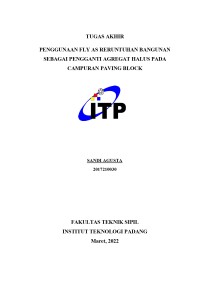
Penggunaan Fly As Reruntuhan Bangunan Sebagai Pengganti Agregat Halus pada Campuran Paving Block
ABSTRACT
Paving block is a building material made from a mixture of cement, sand and water. Paving blocks are widely used in the construction sector, such as sidewalks, highways, parking lots, parks and so on. Ease of installation, cheap maintenance and fulfilling the aesthetic aspects make paving blocks more popular. Along with the increasing use of paving blocks in the community, the use of materials such as cement and sand is also increasing. Sand is a building material that is widely used in construction. Excessive use of sand will cause environmental damage. In this study, a mixture of former building debris was used as a substitute for fine aggregate with variations of 10%, 20%, and 30%. The compressive strength of the design paving blocks is an average of 10 MPa included in grade D which is used for gardens and other uses, with 15 rectangular specimens measuring 20 cm x 10 cm x 6 cm with a test age of 28 days. Based on the test results, the compressive strength of normal paving blocks is 12.7 MPa, 10% of former building ruins are 14.25 MPa, 20% of former building ruins are 12.5 MPa, 30% of former building ruins are 9.75 MPa. . We can see that the effect of using former building debris as a substitute for sand on the compressive strength of paving blocks with variations of 10%, 20% and 30% shows an increase and decrease in the compressive strength of the planned paving block. The highest compressive strength test was obtained at a mixture composition of 10% of former building debris.
Keywords: Paving Block, Former Building Ruins, Compressive Strength
Ketersediaan
Informasi Detail
- Judul Seri
-
Tugas Akhir Teknik Sipil Sarjana
- No. Panggil
-
2221-025
- Penerbit
- Padang : Fakultas Teknik ITP., 2022
- Deskripsi Fisik
-
-
- Bahasa
-
Indonesia
- ISBN/ISSN
-
2017210030
- Klasifikasi
-
NONE
- Tipe Isi
-
text
- Tipe Media
-
computer
- Tipe Pembawa
-
-
- Edisi
-
-
- Subjek
-
-
- Info Detail Spesifik
-
-
- Pernyataan Tanggungjawab
-
Sandi Agusta
Informasi Lainnya
- NIM
-
-
Versi lain/terkait
Tidak tersedia versi lain
Lampiran Berkas
Komentar
Anda harus masuk sebelum memberikan komentar
 Karya Umum
  Filsafat
  Agama
Agama  Ilmu-ilmu Sosial
  Bahasa
  Ilmu-ilmu Murni
  Ilmu-ilmu Terapan
  Kesenian, Hiburan, dan Olahraga
  Kesusastraan
  Geografi dan Sejarah